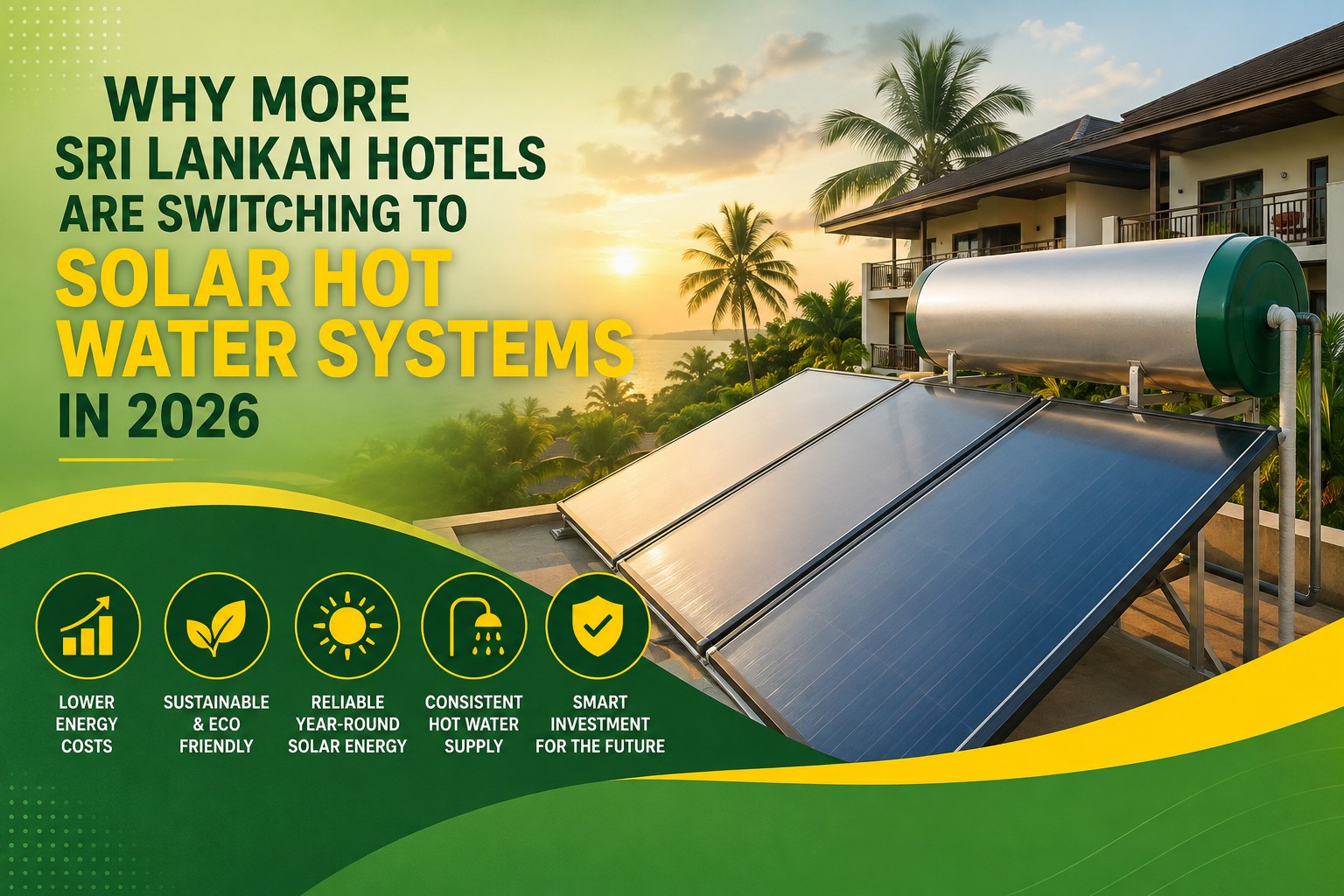
Water heating is one of the largest single electricity costs in any hotel — and in 2026, that cost has become impossible for Sri Lankan hospitality operators to ignore. Solar hot water systems in 2026 are no longer a sustainability gesture for hotels across the island; they are a financially driven operational decision, accelerated by record CEB electricity tariff increases, a national renewable energy push, and growing guest expectations around environmental responsibility.
This guide explains exactly why more Sri Lankan hotels are making the switch this year, what the transition involves, and what hospitality operators should know before investing.
Following successive CEB and LECO tariff revisions, electricity costs for commercial consumers in Sri Lanka have reached historic highs in 2026. For businesses consuming more than 600 units per month — which describes virtually every hotel, guesthouse, and resort — monthly electricity bills have surpassed levels that make grid-powered water heating economically unsustainable at scale.
At the same time, Sri Lanka's government has set a national target of 70% renewable energy generation by 2030, with renewable sources already contributing over 54% to the national grid. Policy support, improved installer networks, and growing awareness of long-term ROI have converged to make solar hot water adoption the most cost-effective immediate step for hospitality operators looking to reduce electricity overheads without compromising guest comfort.
For hotels specifically, solar hot water systems in 2026 offer something grid electricity simply cannot — a stable, predictable cost base for one of the property's highest daily energy demands.
Hotels use hot water continuously and predictably — for guest showers and baths, laundry, kitchen operations, and cleaning. Unlike general electricity consumption, which varies with occupancy, guest behaviour, and seasonal factors, hot water demand in a hotel is relatively consistent and high-volume day after day.
This makes water heating the ideal starting point for solar energy investment in the hospitality sector:
Following the latest CEB tariff adjustments, commercial consumers at higher usage brackets are facing per-unit rates that make electric geyser-based water heating — which consumes enormous amounts of electricity around the clock in a hotel setting — a significant and growing overhead. Solar hot water systems reduce this exposure dramatically, with grid electricity only required for backup heating during periods of low sunlight or peak demand.
At 2026 tariff levels, the payback period for a well-sized solar hot water system in a Sri Lankan hotel is considerably more attractive than it was even two or three years ago. Every unit of hot water produced from solar energy rather than grid electricity represents a direct, ongoing cost saving — and unlike tariff rates, the cost of sunlight doesn't increase.
Sri Lanka's tropical location gives it one of the most reliable solar resources in the region — strong, consistent sunlight for most of the year with minimal seasonal variation compared to temperate climates. Hotels on the south and west coasts, the hill country, and the cultural triangle all benefit from high solar availability, making system performance predictable and consistent.
International travellers — particularly from European and North American markets — increasingly factor environmental credentials into their accommodation choices. A hotel's commitment to renewable energy, documented through certifications and communicated clearly to guests, has become a genuine competitive differentiator. Solar hot water is one of the most visible and verifiable steps a property can take toward credible sustainability credentials.
Sri Lanka's national commitment to 70% renewable energy by 2030 is supported by policy frameworks that make solar investment more accessible. The regulatory environment in 2026 is significantly more supportive of commercial renewable energy adoption than in previous years.
Before designing a system, establish a clear baseline of your hotel's current daily hot water volume, peak usage times, and the electricity cost attributable to water heating. This data is what system sizing and ROI calculations are based on.
Hotel rooftops need to be evaluated for available surface area, sun exposure, shading from higher structures, and structural strength to support collector panels and — for thermosyphon systems — storage tanks. Properties with limited suitable roof space may need to consider active systems with ground or wall-mounted storage.
Hotels typically require commercial-scale solar hot water systems — either large thermosyphon arrays, active direct or indirect systems with centralised storage, or evacuated tube collector systems for higher efficiency at greater scale. The right choice depends on building layout, water quality, daily demand, and roof characteristics.
A hotel cannot risk periods without hot water, which makes backup integration essential. Solar hot water systems should be configured with reliable electric backup elements and intelligent controls that activate only when solar output is insufficient — minimising backup electricity use while guaranteeing guest comfort at all times.
Commercial solar hot water installation is more complex than residential — involving larger system components, more complex plumbing integration, and higher structural considerations. Working with a certified installer who has documented commercial experience is essential.
Commercial solar hot water systems should be professionally serviced at least annually — covering tank cleaning, collector inspection, valve testing, and backup element checks. In a hotel environment, where system failure directly affects guest experience, maintaining a structured servicing schedule is non-negotiable.
Once installed, track monthly electricity consumption against pre-installation baseline figures to document actual savings. Many hotels use this data in guest communications, sustainability reports, and tourism certification applications. St. Anthony's Service's solar hot water service supports hotels through installation, commissioning, and ongoing annual servicing — ensuring systems perform consistently from day one.
1. Why are Sri Lankan hotels switching to solar hot water systems in 2026?
Record CEB electricity tariff increases in 2026, combined with strong solar resource availability and growing guest expectations around sustainability, have made solar hot water systems the most immediately cost-effective renewable energy investment for Sri Lankan hotels.
2. How much can a hotel save by switching to solar hot water?
Savings depend on current water heating electricity costs, system size, and location. Given 2026 tariff levels, hotels with high daily hot water demand typically see significant monthly reductions in electricity expenditure from the first billing cycle after installation.
3. Is solar hot water reliable enough for continuous hotel operations?
Yes — commercial solar hot water systems designed for hotel use include backup electric heating elements and intelligent controls that guarantee continuous hot water supply regardless of sunlight availability.
4. How long does it take for a hotel solar hot water system to pay for itself?
Payback period depends on system size, current electricity tariff exposure, and solar resource at the property's location. At 2026 CEB tariff levels, payback timelines are considerably more attractive than in previous years.
5. What maintenance does a hotel solar hot water system require?
Annual professional servicing covering tank cleaning, collector inspection, valve testing, and backup element checks is the minimum recommended for commercial installations. Higher-usage commercial systems may benefit from more frequent inspections.
6. Can existing hotel buildings be retrofitted with solar hot water systems?
Yes, though retrofit installations require careful assessment of roof structure, existing plumbing, and hot water distribution to design a system that integrates effectively with the property's current infrastructure.
7. Does solar hot water help hotels achieve green certification?
Yes — renewable energy adoption, including solar hot water, is a recognised criterion in most international and regional green tourism and sustainability certification frameworks relevant to Sri Lankan hospitality operators.
8. Who should a hotel contact for commercial solar hot water installation in Sri Lanka?
Hotels should work with certified installers who have documented commercial experience — covering system design, structural assessment, installation, commissioning, and ongoing professional servicing.
Solar hot water systems in 2026 represent one of the clearest and most immediately impactful investments Sri Lankan hotels can make. Rising electricity tariffs, a strong national solar resource, growing guest sustainability expectations, and a supportive policy environment have aligned to make this the year when switching from grid-powered water heating to solar stops being a long-term plan and becomes an urgent operational priority.
Since 1942, St. Anthony's Service has installed, maintained, and serviced solar hot water systems for homes, businesses, and commercial properties across Sri Lanka, with certified technicians and the experience to handle commercial-scale installations correctly from design through to ongoing servicing.
Ready to explore solar hot water for your hotel or hospitality property? Get in touch with our team for a professional site assessment and commercial system recommendation.