If you're considering switching to solar hot water, one of the first things you'll discover is that not all systems work the same way. Understanding the different types of solar water heaters available helps you make a genuinely informed decision — one based on your roof type, household size, water quality, and budget rather than simply choosing the most familiar or most affordable option.
This guide covers every major type of solar water heater, explains how each works, and helps you identify which is the right fit for your home.
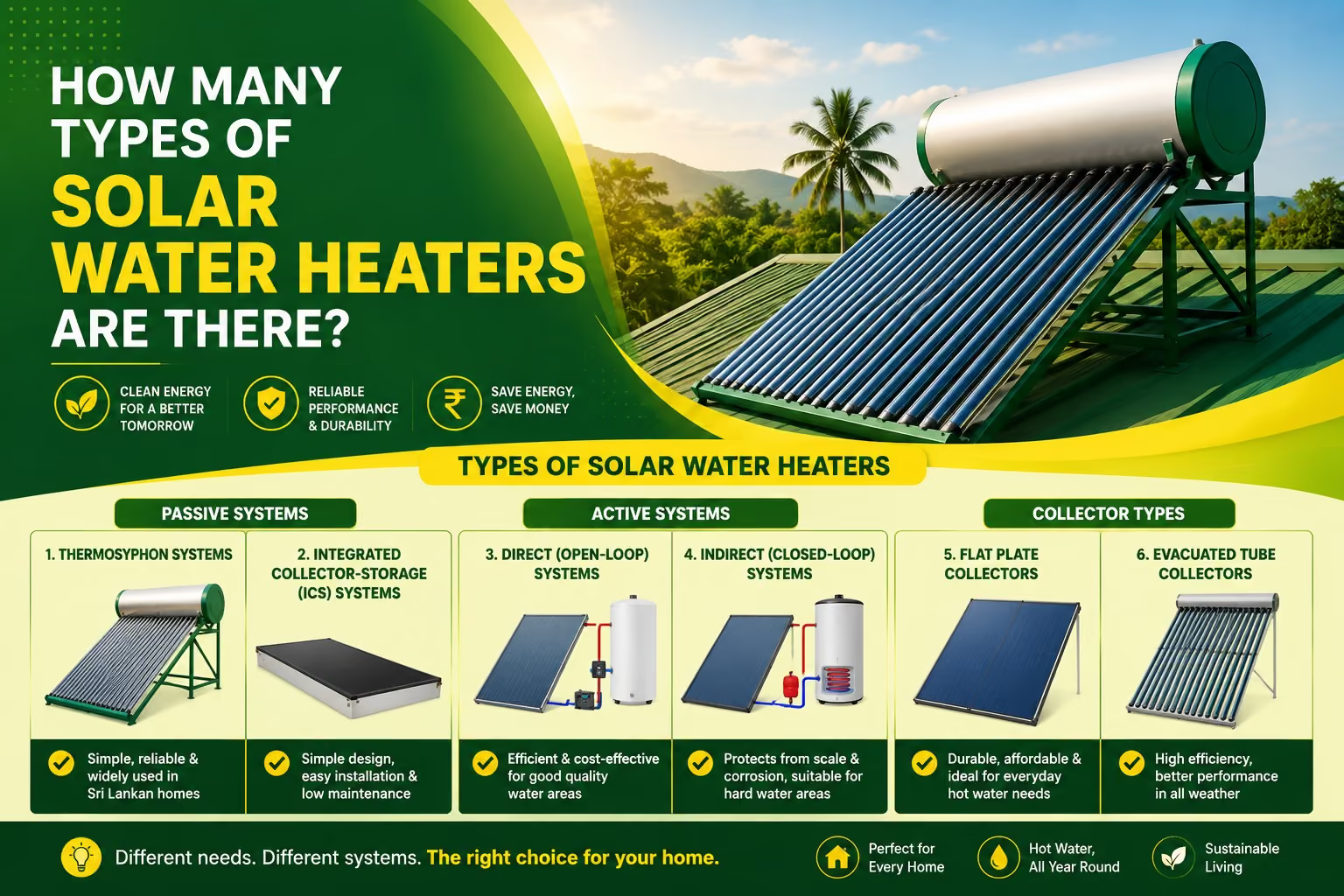
There are two primary categories of solar water heaters — active systems and passive systems — and within each category, several distinct types based on collector design and how water is circulated through the system.
Understanding these categories and their subcategories is the foundation of any informed solar hot water decision.
Passive systems rely on natural convection and gravity to circulate water between the collector and the storage tank, without pumps or electrical components. They are simpler, require less maintenance, and are generally more affordable — making them one of the most widely used types of solar water heaters in Sri Lanka.
Thermosyphon systems are the most common type of passive solar water heater in Sri Lanka. The storage tank is mounted directly above the collector panels on the roof. As the collector heats the water, hot water naturally rises into the tank above while cooler water descends into the collector — a continuous convection loop that requires no pump or controller.
Best for: Households with a roof structure capable of supporting the combined weight of the collector and a full water tank. Widely used in Sri Lankan homes due to their simplicity and reliability.
Key advantages: No moving parts, no electricity required for circulation, low maintenance, long lifespan with proper care.
Key limitation: The tank must be positioned above the collector, which requires sufficient roof height and structural support.
Also known as batch heaters, ICS systems combine the collector and storage tank into a single unit — the water is heated and stored in the same vessel rather than in separate components. These are among the simplest solar hot water systems available.
Best for: Households with mild climates and moderate daily hot water demand. Less common in Sri Lanka than thermosyphon systems but used where simplicity and minimal installation complexity are priorities.
Key advantages: Very simple design, easy installation, minimal components to maintain.
Key limitation: Less efficient in cooler conditions; limited capacity for higher-demand households.
Active systems use pumps and electronic controllers to circulate water or heat transfer fluid between the collector and the storage tank. They offer greater flexibility in system design, better efficiency in variable weather conditions, and allow the tank to be positioned separately from the collector — useful where roof structure or aesthetics are a consideration.
In a direct active system, household water is pumped directly through the collector panels, heated by sunlight, and returned to the storage tank. A pump and controller manage the circulation automatically, typically activating when the collector is warmer than the tank.
Best for: Households in areas with good water quality and low mineral content, where scale buildup inside the collector is less of a concern.
Key advantages: Simple, efficient, and cost-effective for areas with low-mineral water supply.
Key limitation: Direct contact between household water and the collector means scale or corrosion from harder water can affect collector performance over time.
In an indirect active system, a separate heat transfer fluid — typically a food-grade antifreeze solution — circulates through the collector rather than household water. This fluid heats up in the collector and transfers its heat to the household water supply via a heat exchanger in the storage tank.
Best for: Households in areas with hard water or higher mineral content in the water supply, where direct contact between water and collector would cause scale buildup. Also well suited to larger households with higher hot water demand.
Key advantages: Protects the collector from scale and corrosion, compatible with a wider range of water quality conditions, flexible tank placement.
Key limitation: More complex system requiring additional components (heat exchanger, expansion vessel); higher upfront cost than direct systems.
Within both passive and active systems, the type of solar collector used significantly affects performance, efficiency, and cost.
Flat plate collectors are the most common collector type in Sri Lanka — a flat, insulated panel containing a dark absorber plate and a network of pipes or channels through which water or fluid flows. The panel is covered with tempered glass to reduce heat loss.
Best for: Most Sri Lankan residential applications. Effective in the island's tropical climate with strong year-round solar radiation. More affordable than evacuated tube collectors.
Key advantages: Proven technology, durable, widely available, cost-effective for Sri Lanka's climate conditions.
Key limitation: Slightly less efficient than evacuated tubes in lower-light or cooler conditions, though this is less of a factor in Sri Lanka's consistent tropical sunlight.
Evacuated tube collectors consist of a series of glass tubes — each containing an inner tube coated with a solar-absorbing material — with the space between the tubes evacuated of air to minimise heat loss. They are highly efficient at capturing solar energy even in diffuse light conditions.
Best for: Households with higher hot water demand or where maximum efficiency is a priority. Increasingly available in Sri Lanka as an alternative to flat plate collectors.
Key advantages: Higher efficiency than flat plate collectors, particularly in lower-light conditions or for larger households needing consistent high-volume output.
Key limitation: Higher upfront cost than flat plate systems; individual tubes can be replaced if damaged, but the system requires more careful installation.
Passive thermosyphon systems require the tank to be mounted on the roof above the collector — which requires sufficient structural strength. If your roof cannot support this weight, an active system with a ground or wall-mounted tank may be more appropriate.
Households with harder water or higher mineral content benefit from indirect (closed-loop) active systems, which protect the collector from scale buildup. Softer water areas can use direct systems effectively.
Larger households with higher daily hot water usage need a system sized and configured for that demand. Both collector size and tank capacity need to match actual usage patterns rather than being undersized for cost reasons.
Passive thermosyphon systems with flat plate collectors typically represent the most affordable upfront investment. Active systems with evacuated tube collectors cost more initially but may deliver better efficiency returns for specific household profiles.
The collector panels need to be positioned to capture maximum sunlight throughout the day. A professional site assessment will evaluate roof angle, available area, and any shading issues that might affect system performance.
All solar water heater types in Sri Lanka should include a backup electric heating element for cloudy days and periods of peak demand. Confirm this is included in any system you're evaluating and understand how it integrates with your electricity usage.
The right type of solar water heater depends on the combination of all these factors together — not any single one in isolation. St. Anthony's Service's solar hot water service provides professional site assessments that evaluate your roof, water source, household size, and budget to recommend the most appropriate system type for your specific situation.
1. How many types of solar water heaters are there?
There are two primary categories — passive and active systems — with six main types: thermosyphon, integrated collector-storage, direct active, indirect active, flat plate collector systems, and evacuated tube collector systems.
2. What is the most common type of solar water heater in Sri Lanka?
Thermosyphon systems with flat plate collectors are the most widely used type in Sri Lanka, due to their simplicity, reliability, and cost-effectiveness in the island's tropical climate.
3. What is the difference between passive and active solar water heaters?
Passive systems use natural convection and gravity to circulate water, requiring no pump or electricity for operation. Active systems use pumps and controllers to circulate water or fluid, offering greater flexibility in system placement and design.
4. Which type of solar water heater is most efficient?
Evacuated tube collectors generally offer higher efficiency than flat plate collectors, particularly in lower-light conditions. However, for most Sri Lankan homes with consistent tropical sunlight, flat plate collector systems deliver very strong performance at a lower cost.
5. What is the difference between direct and indirect solar water heaters?
In a direct system, household water flows directly through the collector panels. In an indirect system, a separate heat transfer fluid circulates through the collector and transfers heat to the household water via a heat exchanger — protecting the collector from scale in harder water areas.
6. Which type of solar water heater is best for a Sri Lankan home?
For most Sri Lankan homes, a passive thermosyphon system with flat plate collectors provides the best balance of performance, reliability, and cost. Households with harder water, larger demand, or specific roof constraints may benefit from an active system or evacuated tube collectors.
7. How long do different types of solar water heaters last?
With proper maintenance, most solar water heater types can deliver many years of reliable service. Flat plate collectors and thermosyphon systems in particular are known for long operational lifespans when serviced annually.
8. Does the type of solar water heater affect maintenance requirements?
Yes. Passive systems with fewer components generally require less maintenance than active systems with pumps and controllers. Indirect systems require periodic heat transfer fluid checks in addition to standard tank and collector maintenance.
There are several distinct types of solar water heaters, and the right choice depends on more than just price. Roof structure, water quality, household size, and long-term efficiency goals all influence which system type will deliver the best results for your home. Taking the time to understand these options — and getting a professional assessment before committing — is what ensures your system performs as expected for years to come.
Since 1942, St. Anthony's Service has supplied, installed, and maintained solar water heaters across Sri Lanka, with certified technicians and genuine expertise across all system types.
Not sure which type is right for your home? Get in touch with our team for a professional site assessment and honest recommendation.